1. Petitions against the Treaty
Opponents of the Treaty of Union sought to defeat it with a petitioning campaign. This campaign was unusually large and organised for the early eighteenth century. At least 20,000 people signed 85 petitions from 123 different shires, burghs and organisations:
- 15 shires
- 21 royal burghs
- 9 burghs of barony (burghs represented in parliament by their shire commissioner)
- 51 parishes
- 3 presbyteries (a regional church body representing a group of parishes)
- Company of Scotland Trading to Africa and the Indies (the joint stock company that had attempted to settle Darien)
- Convention of Royal Burghs (a national assembly that met regularly to discuss trade and taxation)
- Commission of the General Assembly of the Church of Scotland (an executive body responsible for church affairs when the General Assembly was not in session)
- United Societies (a body of separatist presbyterians in the southwest, also known as Cameronians)
In a pamphlet published in July 1706, the minister of Hamilton parish, Robert Wylie, argued that the Treaty of Union required the consent of the freeholders of Scotland. He insisted that those holding land and political rights from the king by royal charter could not be forced to give up their right of representation in the Scottish Parliament without their consent. The leaders of the Country party sought to demonstrate the objections of freeholders by organising a petitioning campaign.
The organisers wrote a petition text and circulated it to friends and followers in the shires. This was carefully written to be acceptable to Presbyterians and Jacobites. The shires were most likely to use the provided text, while the burghs and parishes more often added to this text or wrote their own. In most cases, this allowed Presbyterians to express their religious concerns about the proposed union. Most petitions came from areas within a day or two of travel from Edinburgh. The most northerly were from Perthshire and Aberdeenshire.
Local Petitions in Parliament
Petitions from localities can be found on the online Records of the Parliaments of Scotland to 1707. Use the Advanced Search to search for ‘address’ for the reign of Anne and the 1706 session. Petitions were read in Parliament between October 1706 and January 1707.
Petition from Stirling
A petition from the royal burgh of Stirling was read in parliament on 23 November 1706. See www.rps.ac.uk/1706/10/85.
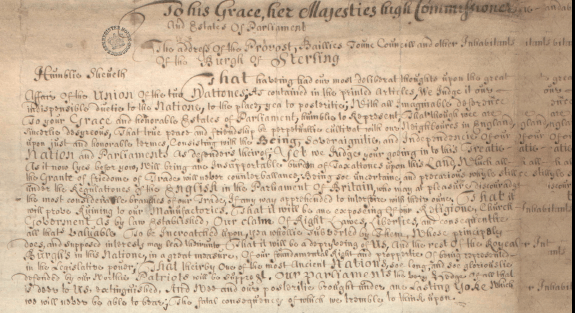
The National Records of Scotland has made a transcription of the burgh of Stirling’s petition. This text was used also by the nearby parish of Culross. It is not the standard text circulated by the organisers. It illustrates typical concerns from a presbyterian point of view.
- Support for an ‘honourable’ union with England in which the Scottish kingdom, parliament and church remained intact.
- Concern for the heavy burden of taxation created by the extension of English customs and excise taxes to Scotland to allow free trade between Scotland, England and England’s colonies.
- Worry that gains from trading with English colonies would not balance out the negative impact of higher taxes and the loss of protectionist legislation designed by the Scottish parliament for the Scottish economy.
- Distrust of a British Parliament with a large English majority. In the proposed union of parliaments, Scotland would hold only about 10% of the seats in the British House of Commons.
- Fear that the British Parliament with a large Anglican majority would pass acts to disestablish the presbyterian Church of Scotland.
- Loss of the right of Stirling and other royal burghs to be represented in parliament.
- A humiliating loss of the ancient sovereignty of the Scottish kingdom. The realm was believed to be one of the oldest monarchies in the known world. Scots at the time were proud that Scotland’s supposed 2,000 year old monarchy had remained intact and unconquered.
The Stirling petition was organised by the burgh provost, Lt. Col. John Erskine of Carnock. In a letter to London, the author and English spy Daniel Defoe reported that the provost drew up the town militia, consisting of able bodied men aged 16 to 60, and presented the petition to them to sign. The paper contains 564 signatures including many of the town’s leaders: Erskine of Carnock, four baillies, the town treasurer, four councillors and four deacon convenors of the trades. Early in December, a group of men, including some town officers, built a fire and burned the articles of the treaty at the mercat (market) cross in a further act of protest.
Despite these statements of opposition, the burgh representative for Stirling voted for the treaty. Also named Lt. Col. John Erskine, this Erskine served as deputy-governor of Stirling Castle. This post would have been given to him by his kinsman, the Earl of Mar, who was the hereditary keeper of the castle for the queen. Mar was one of the leaders of the Court coalition in favour of the queen’s policy of incorporating union.
Who decides: parliament or people?
In the early eighteenth century, the opinion of ordinary people was much less respected than today. Parliament was considered to be the embodiment of the political nation. Members of parliament were meant to judge what was best for the nation. In this letter written during the parliamentary debates, the earl of Mar indicated his disdain for the petitioners: ‘It was certaine they did not understand it, nor were they capable nor fitt judges’ (pp. 323-4).
Mar’s letter shows the cynical view of petitioners taken by the queen’s ministers. He felt they should be discounted because they were organised by local elites. However, in some cases, petitions were signed without local authority. In the burgh of Ayr, a petition was circulated without the approval of the burgh council and was signed by over 1,000 inhabitants.
It is likely that many signatories did understand local petitions and signed them freely. Closer union had been proposed unsuccessfully by Queen Anne in 1702 and increasing numbers of pamphlets on Anglo-Scottish relations had been published since then. Church ministers, landowners and merchants took a keen interest in the question of union. Many people across Scotland, especially in regions nearest to Edinburgh, would have been aware that a treaty of union was being debated by the Scottish Parliament. There is evidence that local magistrates or ministers made speeches or sermons explaining the petition before it was presented for signature. A letter by Daniel Defoe reports that Robert Wylie did this in his parish of Hamilton.
Campaign to address the queen
Negative public opinion was one of the best weapons available to the opponents of the treaty. The petitions were used to argue that the queen should be informed of the strength of popular opposition to the treaty. Mar’s letter reported that the Duke of Hamilton (one of the leaders of the Country party) proposed to the Duke of Queensberry (the Queen’s Commissioner) that Queensberry should communicate to Queen Anne ‘the humour [opinions] of the countrie against this Union, which appeared by the addresses’ (p. 323). Hamilton proposed a recess for this to happen. He also suggested that the queen should pursue an act for the settlement of the Hanoverian succession instead of the treaty of union. (These had been the two options imposed on Scotland by the 1705 Aliens Act.)
The petition from Stirling also proposed a recess: ‘That some Recess may be granted untill some expedient be found out for the more universall satisfactione Of her Majesties good subjects’ (p. 323). This indicates the coordination of messages between politicians in Edinburgh and their friends in places like Stirling. The effect was to highlight the opinion of subjects at large, setting the views of many people in Stirling against the Court party majority in the Scottish Parliament.
Mar’s letter shows that on 16 November 1706, Lord Belhaven proposed that the vote on Article 2 for a union of parliaments should be to approve the article or address the queen. Like his relative the Duke of Hamilton, he wanted the Scottish Parliament to tell Queen Anne about the opposition shown by the addresses and ask her to give up her union policy. The proposal for an address to the queen was defeated by the Court party majority, as Mar describes in his letter (p. 325).
In December, the Duke of Athol (a leader of the Country party) tried to organise the signing of an address to the queen. He and his supporters wrote letters encouraging gentlemen to travel to Edinburgh to sign an address. Reports noted that Edinburgh was swelled with visitors despite the winter weather. The address failed for two reasons:
- The Duke of Athol and Duke of Hamilton disagreed on what to ask the queen to do. Hamilton argued that the address should propose a settlement of the Hanoverian succession as an alternative to union. Athol and his Jacobite friends couldn’t support this.
- While they argued, the government took action. A proclamation was made on 27 December 1706 banning unauthorised meetings in Edinburgh (Records of the Parliament of Scotland to 1707, 1706/10/176). This stated that petitioners should ‘rest assured and contented’ that the Scottish Parliament would proceed to consider the treaty with regard to their concerns, and condemned those who had presumed to come to Edinburgh ‘in considerable numbers and tumultuous manner, from several corners of this kingdom’. The gathering of petitioners in Edinburgh was deemed ‘unwarrantable and seditious’ and the subjects were banned from congregating without authority by law.
A last effort was made on 7 January to call for an address to the queen. The Duke of Athol made a protestation in parliament critiquing the terms of representation for Scotland in the proposed union and citing the petitions as evidence of popular discontent (Records of the Parliament of Scotland to 1707, 1706/10/212). Athol noted the ‘multitudes of addresses and petitions’ in arguing that the queen needed to be ‘fully informed of the inclinations of her people’. Athol recommended new elections for a parliament more in touch with ‘the immediate sentiments of the nation’.
The Duke of Hamilton was meant to offer a similar protestation and then lead the opposition out of the chamber, but he refused to act. He claimed to be unable to come to Parliament because of a toothache. His friends insisted that he attend, but he would not join Athol in making a protest or leading the walk-out.
Could a walk-out and address to the queen have disrupted the session enough to stop the union? This is a significant counter-factual question. Hamilton had led a walk-out in 1702 to protest a delay in calling parliament to meet after William’s death. He and his followers addressed the queen, but she refused the address and sent them back to speak to her Commissioner in Edinburgh. In 1707, would the addresses from localities have given an address by the opposition more leverage? Or were they too late, given that the petitioners who gathered in December had been sent home? A present-day example of a walk-out can be found in Texas. In June 2021, Democrats left the state legislature to delay a vote on a controversial bill regulating elections in Texas.
2. Protest events, rioting, musters and attempted risings
The threat of violent resistance was part of the leverage offered by public opinion. Within living memory, armed opposition had helped to make the Revolution of 1688-90. A future article will discuss attempts to stop the passage of the union treaty with protest events, rioting, musters and an armed revolt.
 Teaching the Treaty of the Union